This study explores the effectiveness of various herbicides in enhancing upland rice production in the Fogera Plain of Ethiopia, a region recognized for its agricultural potential yet challenged by significant weed infestations. Despite a notable increase in both cultivated area and total rice output, the productivity in Ethiopia remains below the global average, primarily due to the adverse effects of weeds. To address this issue, a trial was conducted using a randomized complete block design (RCBD) during the 2023 rainy season, evaluating the impacts of Keeper herbicide, Pallas 45 OD, and manual weeding on key growth parameters, including grain yield, dry weight of weed biomass, panicle length, and spikelet count. The results indicated that the treatment involving two rounds of manual weeding achieved the highest grain yield of 3337.72 kg ha-1, significantly surpassing the unsprayed control yield of 763.69 kg ha-1. The Keeper herbicide yielded 2625.00 kg ha-1, while the Pallas 45 OD herbicide resulted in a lower yield of 1686.40 kg ha-1, demonstrating their effectiveness in managing weed competition, although with reduced yields compared to manual weeding. Furthermore, the economic analysis revealed that the Keeper herbicide treatment generated a greater net benefit compared to manual weeding, affirming its practicality as a viable alternative for weed management. This research highlights the necessity for integrated weed management strategies in Ethiopia’s rice production systems, emphasizing the potential of combining herbicides with traditional practices to mitigate the challenges posed by weeds and enhance agricultural productivity.
This is an Open Access article, distributed under the terms of the Creative Commons Attribution 4.0 International License (http://creativecommons.org/licenses/by/4.0/), which permits unrestricted use, distribution and reproduction in any medium or format, provided the original work is properly cited.
. Within in Africa, rice holds a significant position, ranking fifth in terms of harvested land area and fourth in production volume (2). In sub-Saharan Africa, 39% of production ecosystems are suitable for upland rice production
[2]
Rodenburg, J., Johnson, D. E. (2009). Weed management in rice‐based cropping systems in Africa. Advances in Agronomy, Elsevier, pp 149–218.
. In Ethiopia, rice has been designated a "millennium crop," reflecting its increasing importance in the country's agricultural landscape
[3]
Alemu, D., Thompson, J. (2020). The emerging importance of rice as a strategic crop in Ethiopia. Agricultural Policy Research in Ethiopia (APRA), A Working Paper 44.
[3]
. Over recent years, rice production in Ethiopia has surged from a mere 10,000 tons cultivated on 5,400 hectares to an impressive 189,649 tons across 62,551 hectares, achieving a national average yield of 3 tons per hectare
[4]
FAOSTAT. (2022). Statistical databases and data sets of Food and Agricultural Organization of the United Nations report on Crops and livestock products.
[4]
. Despite this remarkable increase in both production volume and harvested area of 94.7% and 91.4%, respectively. The productivity of rice in Ethiopia remains considerably below the global average yield of 4.54 tons per hectare
[5]
Clarke N., Bizimana J. C., Dile Y., Worqlul A., Osorio J., et al. (2017). Evaluation of new farming technologies in Ethiopia using the Integrated Decision Support System (IDSS). Agricultural Water Management, 180: 267-279.
[5]
.
The primary factor contributing to this productivity gap is the severe weed infestation that plagues rice fields across the nation. Weeds pose a significant challenge, being the major yield-limiting constraint in rice production, with studies indicating an alarming average yield loss of up to 90% due to weed competition
[6]
Berhan, M., Bekele, D. (2021). Review of Major Cereal Crops Production Losses, Quality Deterioration of Grains by Weeds and Its Prevention in Ethiopia. Asian Journal of Advances in Research, 4, 1214–1225.
[6]
. In sub-Saharan Africa, the toll is staggering; weeds account for a loss of approximately 2.2 million tons of milled rice annually
[2]
Rodenburg, J., Johnson, D. E. (2009). Weed management in rice‐based cropping systems in Africa. Advances in Agronomy, Elsevier, pp 149–218.
. The repercussions of these weed infestations extend beyond mere yield reductions. They also escalate the cost of cultivation, diminish input efficiency, hinder agricultural operations, compromise the quality of the harvested crop, and serve as alternate hosts for a variety of insect pests and diseases. The extent of losses attributed to weeds can vary significantly from one region to another, as the nature, severity, and intensity of weed pressures are influenced by ecological factors, hydrology, land topography, planting methods, and overall management practices.
In the Fogera Plain, small-scale rice farmers typically rely on hand weeding as their primary weed management strategy. While effective at a small scale, this method is not viable for large-scale rice production, where labor costs for weed management can represent up to 44.56% of total production expenses
[7]
Abera, S., Bekele, A., Assaye, A., Melak, A. (2019). Cost and return analysis of rain fed lowland rice production under smallholder farmers in Fogera district, north western Ethiopia. International Journal of Research Studies in Agricultural Sciences, 5, 30–35.
[7]
. Moreover, hand weeding is a time-consuming practice that can detract from other essential farming activities. Recent studies have highlighted the potential of herbicides as a viable alternative for managing weed infestations effectively. For instance, research indicates that herbicides can significantly mitigate weed competition and enhance crop yields
[8]
Habtegebrial, G. D. (2019). Response of Rice to Fertilizer in Ethiopia. Advances in Rice Research and Development in Ethiopia, 131.
[8]
.
Applying Keeper herbicide at a rate of 1 L/ha in the upland rice production ecosystem effectively controlled grass and broadleaf weeds, providing a 62.8% grain yield advantage over the weedy check and a non-significant grain yield with two times hand weeding
[9]
Zeleke, T., Degu, T., Gudisa, T., Birhan, M. (2019). Rice Weed Species and Weed Management in Ethiopia. Advances in Rice Research and Development in Ethiopia, 147.
[9]
. However, the effectiveness of the herbicide varies from location to location due to differences in weed species and environmental conditions
[10]
Hughes, M. (2020). Herbicide performance: environmental factors.
. Hence, confirming the efficacy of Keeper herbicide in Fogera conditions is fundamental before demonstrating the chemical.
2. Material and Methods
2.1. Description of the Study Area
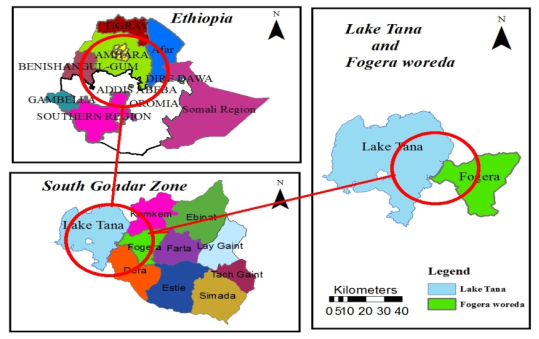
The trial was conducted at a single location, the Fogera National Rice Research and Training Center, situated in the Fogera Plain of Ethiopia (Figure 1), which is characterized by its unique agroecological conditions suitable for rice production. The study in the Fogera area is located between latitudes 11°54.4'N and 11°57'N and longitudes 37°41.4'E and 37°42.5'E, at an elevation ranging from 1787 to 1812 meters above sea level. The site experiences minimum and maximum temperatures of 12.75°C and 27.37°C, respectively, and receives an average annual rainfall of 1219 mm. The soil at the experimental site was identified as heavy clay, with a pH range of 5.87 to 6.63, indicating that it is slightly acidic.
The trials were conducted during the 2023 rainy season, employing a randomized complete block design (RCBD) with three replications to account for variability in environmental conditions. Each plot measured 12 m² (3 m x 4 m), with 0.5 m pathways between plots and 1 m between replications to minimize cross-contamination and facilitate management activities. The spacing between rows was 20 cm. The new variety for Africa, NERICA-4, was used, with a seed rate of 120 kg/ha. Additionally, 300 kg of UREA and 230 kg of NPS fertilizer were applied.
The study incorporated five distinct treatments the first treatment utilized Keeper herbicide (Cyhalofop-butyl and Fluroxypyr-meptyl EC 414), applied at the 2-4 leaf stage with one liter per hectare by mixing with 400 liters of water. The second treatment involved Pallas 45 OD (Pyroxasulfone), applied post-emergence against grass weeds 30 to 35 days after the emergence of annual broadleaf weeds, targeting peak weed vulnerability. The third treatment employed manual weeding, with two rounds of hand weeding conducted during critical stages of rice growth particularly 25 days after sowing and 48 days after sowing, allowing precise weed removal without disturbing the rice plants. Finally, the fourth treatment was an unsprayed control, where no herbicide or manual intervention was applied, serving as a baseline to assess the effectiveness of the other treatments.
2.3. Data Collection
A 100 cm × 100 cm quadrat was used for weed sampling at the crop's harvesting stage, randomly placed in two locations within each plot. Weeds were harvested at ground level, identified by species, counted, and recorded. The collected species were cleaned, dried at 70°C for 72 hours, and weighed using a sensitive analytical balance. This process provided essential data for calculating Weed Control Efficiency (WCE) using a specific formula.
WCE=X100
Apart from weed parameters, several plant growth parameters were measured at different stages of rice development. Plant height was recorded from the base to the tip of the upper leaves of the main stem at maturity stages, providing insights into the growth response of rice to the treatments. Panicle length was measured from the base to the tip of the panicle of ten randomly selected plants per plot just before harvesting, while the number of spikelets per panicle was counted from ten plants at the harvesting stage to evaluate productivity metrics. Finally, the grain yield for each plot was measured at harvest and expressed in kilograms per hectare (kg/ha).
2.4. Economic Analysis
An economic analysis evaluates the cost-effectiveness of various treatments
[11]
CIMMYT. (1988). From agronomic data to farmer recommendations: An economics training manual (Completely revised ed.). Mexico, D. F.: CIMMYT.
[11]
. The amount of commercial herbicide needed per hectare was assessed, allowing for the estimation of costs based on market prices. Labor costs for manual and herbicide application were estimated at 300 birr for a single person, which was then converted to a per-hectare basis to reflect the actual cost of weed control for one hectare of rice field. Additionally, the average market price for rice during the study period was recorded at 32 birr per kilogram.
2.5. Statistical Analysis
All collected data were analyzed using the R statistical software package. Analysis of variance (ANOVA) was performed, and significant differences were assessed using the LSD test at a 5% significance level.
3. Results and Discussion
3.1. Effect of Treatments on Grain Yield
The analysis of rice grain yield, as presented in Table 1, reveals significance differences among various weed management practices. The weeded-twice treatment yielded the highest grain yield (3337.72 kg ha-1), representing a remarkable 4.37-fold increase compared to the unsprayed control (763.69 kg ha-1), and this finding aligns with the results of previous studies
[12]
Ahmed, S., Chauhan, B. S. (2014). Performance of Different Herbicides in Dry-Seeded Rice in Bangladesh. The Scientific World Journal, 1–14.
. In contrast, the Keeper herbicide treatment produced 2625.00 kg ha-1, marking a 3.44-fold increase, while the Pallas 45 OD herbicide yielded 1686.40 kg ha-1, showing a 2.21-fold increase over the unsprayed control, this finding was similar with the findings of Choudhary and Dixit
[13]
Choudhary, V. K., Dixit, A. (2018). Herbicide weed management on weed dynamics, crop growth and yield in direct-seeded rice.
[13]
, herbicide sprayed treatments have been low rice grain yield than two times hand weeding and high rice grain yield than the unsprayed control.
3.2. Effect of Treatments on Dry Weight Weeds Biomass
The result indicated in Table 1 showed that dry-weight weed biomass across different treatments had a significant difference. The weeded twice treatment yielded the lowest dry-weight weed biomass at 282.89 kg ha-1, resulting in a remarkable 13-fold decrease compared to the unsprayed control, which had the highest biomass at 3680.32 kg ha-1. This finding aligns with the results reported by Abdullah et al.
[14]
Abdullah, M., et al. (2020). Studies on the efficacy of different herbicides in controlling weeds in rice. Journal of Crop Protection, 9, 11–15.
[14]
. The Keeper herbicide treatment produced a biomass of 958.45 kg ha-1, accounting for a 3.84-fold decrease relative to the unsprayed control, while the Pallas 45 OD herbicide showed a 2.33-fold decrease with a biomass of 1574.56 kg ha-1.
3.3. Effect of Treatments on Panicle Length and Spikelets/Panicle
The findings presented in Table 1 clearly illustrate that there exists a statistically significant variation in panicle length among the various treatments applied. The weeded twice treatment achieved a panicle length of 14.88 cm, while the Keeper herbicide treatment recorded the longest panicle at 16.27 cm. However, despite the latter's longer panicle, it yielded less grain, suggesting that other factors contribute to yield beyond just panicle length. The number of spikelets per panicle also varied significantly. The weeded twice treatment yielded 73.27 spikelets per panicle, whereas the Keeper herbicide treatment achieved 81.47 spikelets per panicle, indicating its effectiveness in enhancing spikelet development.
Table 1. Mean separation of plant height, dry weight weed biomass, number of spikelets/panicle, panicle length, and grain yield of rice in the 2023 main season.
Treatments
Yield (kg/ ha)
DWWB (kg/ha)
PH (cm)
PL (cm)
NSPP
Twice weeded
3337.72a
282.89d
65.27a
14.88a
73.27a
Keeper
2625.00ab
958.45c
65.93a
16.27a
81.47a
Pallas 45 OD
1686.40bc
1574.56b
65.00a
15.31a
75.53a
Unsprayed
763.70c
3680.32a
67.33a
15.81a
73.00a
LSD
1216.48
586.05
6.99
2.21
17.08
Mean
2103.20
1624.06
65.88
15.57
75.82
CV (%)
30.72
19.20
5.64
7.50
11.97
DWWB= Dry weight weed biomass, PH= Plant height, PL= Panicle length, NSSP= Number of spikelets/panicle.
CV (%)= coefficient of variation, LSD= List significant difference at 5% means with the same latter is not significance difference.
3.4. Effect of Treatments on the Percent of Weed Control Efficiency
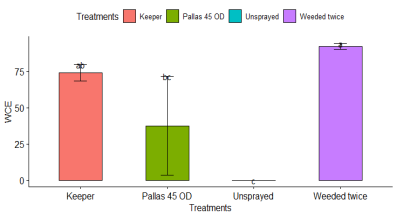
The results of weed control efficiency, illustrated in Figure 2, indicate significant differences among the various treatments when compared to the Unsprayed Control. The Weeded Twice treatment was the most effective, achieving 90.5% efficiency with a fold increase of 1.50, showing the strong impact of manual weeding on reducing weed pressure this finding correlated with
[12]
Ahmed, S., Chauhan, B. S. (2014). Performance of Different Herbicides in Dry-Seeded Rice in Bangladesh. The Scientific World Journal, 1–14.
. The Keeper Herbicide treatment followed with 85.2% efficiency and a fold increase of 1.42, indicating its effectiveness but suggesting it is less robust than manual methods. Lastly, the Pallas 45 OD Herbicide yielded the lowest effectiveness at 75.8% efficiency and a fold increase of 1.26, showing it provides less effective weed control relative to the other treatments.
The result presented in Table 2 indicates that the Keeper herbicide treatment generated a significantly higher net benefit compared to manual weeding treatments. This finding supports the conclusion that Keeper herbicide serves as an effective alternative for weed management, offering both a higher net cost-benefit and greater economic value than manual weeding. These results align with previous research, which demonstrates that herbicide applications can yield substantially higher net benefits compared to manual weeding
[15]
Hussain, S., Ramzan, M., Akhter, M., Aslam, M. (2008). Weed management in direct seeded rice. Journal of Animal and Plant Sciences, 18, 86–88.
[16]
Islam, T., Bhowmic, M. K., Ghosh, R. K., Sounda, G. (2000). Effect of pretilachlor on weed control and yield of transplanted rice. Environmental Ecology, 19, 265–268.
[15, 16]
.
Table 2. Cost-effectiveness of weed management treatments.
Treatments
Herbicides cost (Birr/ha)
Labor cost for spraying/ weeding (Birr/ha)
Total cost (Birr/ha)
Gross income (Birr/ha)
Net Benefit (Birr/ha)
Twice weeded
0.00
30,000
30,000
106,806.4
76,806.4
Keeper
2500
1,200
3,700
84,000
80,300
Pallas 45OD
4000
1,200
5,200
53,964.8
48,764.8
Unsprayed
0
0
0
24,438
24,438
4. Conclusion
This study highlights the vital role of effective weed management in improving upland rice production in Ethiopia's Fogera Plain. By evaluating herbicides like Keeper and Pallas 45 OD alongside manual weeding, we found that integrating herbicides can boost grain yields and address weed issues. While manual weeding yields the best results, Keeper offers a practical alternative with notable benefits. Weed competition significantly reduces rice productivity in Ethiopia, emphasizing the need for integrated weed management strategies that combine chemical and manual approaches. The economic analysis supports the use of herbicides, especially Keeper, as a cost-effective option for smallholder farmers facing labor and production cost challenges.
Abbreviations
RCBD
Randemized Complete Block Design
LSD
List Significance Difference
NERICA-4
The New Variety for Africa
ANOVA
Analysis of Variance
Acknowledgments
The author extends their gratitude to the Ethiopian Institute of Agricultural Research (EIAR) for their invaluable financial and logistical support.
Author Contributions
Yinebeb Abebaw Bekele is the sole author. The author read and approved the final manuscript.
Conflicts of Interest
The author declares no conflicts of interest.
References
[1]
Fukagawa, N. K., Ziska, L. H. (2019). Rice: Importance for Global Nutrition. J Nutr Sci Vitaminol, 65, S2–S3.
Alemu, D., Thompson, J. (2020). The emerging importance of rice as a strategic crop in Ethiopia. Agricultural Policy Research in Ethiopia (APRA), A Working Paper 44.
[4]
FAOSTAT. (2022). Statistical databases and data sets of Food and Agricultural Organization of the United Nations report on Crops and livestock products.
[5]
Clarke N., Bizimana J. C., Dile Y., Worqlul A., Osorio J., et al. (2017). Evaluation of new farming technologies in Ethiopia using the Integrated Decision Support System (IDSS). Agricultural Water Management, 180: 267-279.
[6]
Berhan, M., Bekele, D. (2021). Review of Major Cereal Crops Production Losses, Quality Deterioration of Grains by Weeds and Its Prevention in Ethiopia. Asian Journal of Advances in Research, 4, 1214–1225.
[7]
Abera, S., Bekele, A., Assaye, A., Melak, A. (2019). Cost and return analysis of rain fed lowland rice production under smallholder farmers in Fogera district, north western Ethiopia. International Journal of Research Studies in Agricultural Sciences, 5, 30–35.
[8]
Habtegebrial, G. D. (2019). Response of Rice to Fertilizer in Ethiopia. Advances in Rice Research and Development in Ethiopia, 131.
[9]
Zeleke, T., Degu, T., Gudisa, T., Birhan, M. (2019). Rice Weed Species and Weed Management in Ethiopia. Advances in Rice Research and Development in Ethiopia, 147.
[10]
Hughes, M. (2020). Herbicide performance: environmental factors.
Choudhary, V. K., Dixit, A. (2018). Herbicide weed management on weed dynamics, crop growth and yield in direct-seeded rice.
[14]
Abdullah, M., et al. (2020). Studies on the efficacy of different herbicides in controlling weeds in rice. Journal of Crop Protection, 9, 11–15.
[15]
Hussain, S., Ramzan, M., Akhter, M., Aslam, M. (2008). Weed management in direct seeded rice. Journal of Animal and Plant Sciences, 18, 86–88.
[16]
Islam, T., Bhowmic, M. K., Ghosh, R. K., Sounda, G. (2000). Effect of pretilachlor on weed control and yield of transplanted rice. Environmental Ecology, 19, 265–268.
Bekele, Y. A. (2025). Evaluation of Herbicides on Upland Rice (Oryza sativa L.) Production in Fogera Plain, Northwestern Ethiopia. International Journal of Data Science and Analysis, 11(2), 17-22. https://doi.org/10.11648/j.ijdsa.20251102.11
Bekele, Y. A. Evaluation of Herbicides on Upland Rice (Oryza sativa L.) Production in Fogera Plain, Northwestern Ethiopia. Int. J. Data Sci. Anal.2025, 11(2), 17-22. doi: 10.11648/j.ijdsa.20251102.11
Bekele YA. Evaluation of Herbicides on Upland Rice (Oryza sativa L.) Production in Fogera Plain, Northwestern Ethiopia. Int J Data Sci Anal. 2025;11(2):17-22. doi: 10.11648/j.ijdsa.20251102.11
@article{10.11648/j.ijdsa.20251102.11,
  author = {Yinebeb Abebaw Bekele},
  title = {Evaluation of Herbicides on Upland Rice (Oryza sativa L.) Production in Fogera Plain, Northwestern Ethiopia
},
  journal = {International Journal of Data Science and Analysis},
  volume = {11},
  number = {2},
  pages = {17-22},
  doi = {10.11648/j.ijdsa.20251102.11},
  url = {https://doi.org/10.11648/j.ijdsa.20251102.11},
  eprint = {https://article.sciencepublishinggroup.com/pdf/10.11648.j.ijdsa.20251102.11},
  abstract = {This study explores the effectiveness of various herbicides in enhancing upland rice production in the Fogera Plain of Ethiopia, a region recognized for its agricultural potential yet challenged by significant weed infestations. Despite a notable increase in both cultivated area and total rice output, the productivity in Ethiopia remains below the global average, primarily due to the adverse effects of weeds. To address this issue, a trial was conducted using a randomized complete block design (RCBD) during the 2023 rainy season, evaluating the impacts of Keeper herbicide, Pallas 45 OD, and manual weeding on key growth parameters, including grain yield, dry weight of weed biomass, panicle length, and spikelet count. The results indicated that the treatment involving two rounds of manual weeding achieved the highest grain yield of 3337.72 kg ha-1, significantly surpassing the unsprayed control yield of 763.69 kg ha-1. The Keeper herbicide yielded 2625.00 kg ha-1, while the Pallas 45 OD herbicide resulted in a lower yield of 1686.40 kg ha-1, demonstrating their effectiveness in managing weed competition, although with reduced yields compared to manual weeding. Furthermore, the economic analysis revealed that the Keeper herbicide treatment generated a greater net benefit compared to manual weeding, affirming its practicality as a viable alternative for weed management. This research highlights the necessity for integrated weed management strategies in Ethiopia’s rice production systems, emphasizing the potential of combining herbicides with traditional practices to mitigate the challenges posed by weeds and enhance agricultural productivity.
},
 year = {2025}
}
TY  - JOUR
T1  - Evaluation of Herbicides on Upland Rice (Oryza sativa L.) Production in Fogera Plain, Northwestern Ethiopia

AU  - Yinebeb Abebaw Bekele
Y1  - 2025/05/24
PY  - 2025
N1  - https://doi.org/10.11648/j.ijdsa.20251102.11
DO  - 10.11648/j.ijdsa.20251102.11
T2  - International Journal of Data Science and Analysis
JF  - International Journal of Data Science and Analysis
JO  - International Journal of Data Science and Analysis
SP  - 17
EP  - 22
PB  - Science Publishing Group
SN  - 2575-1891
UR  - https://doi.org/10.11648/j.ijdsa.20251102.11
AB  - This study explores the effectiveness of various herbicides in enhancing upland rice production in the Fogera Plain of Ethiopia, a region recognized for its agricultural potential yet challenged by significant weed infestations. Despite a notable increase in both cultivated area and total rice output, the productivity in Ethiopia remains below the global average, primarily due to the adverse effects of weeds. To address this issue, a trial was conducted using a randomized complete block design (RCBD) during the 2023 rainy season, evaluating the impacts of Keeper herbicide, Pallas 45 OD, and manual weeding on key growth parameters, including grain yield, dry weight of weed biomass, panicle length, and spikelet count. The results indicated that the treatment involving two rounds of manual weeding achieved the highest grain yield of 3337.72 kg ha-1, significantly surpassing the unsprayed control yield of 763.69 kg ha-1. The Keeper herbicide yielded 2625.00 kg ha-1, while the Pallas 45 OD herbicide resulted in a lower yield of 1686.40 kg ha-1, demonstrating their effectiveness in managing weed competition, although with reduced yields compared to manual weeding. Furthermore, the economic analysis revealed that the Keeper herbicide treatment generated a greater net benefit compared to manual weeding, affirming its practicality as a viable alternative for weed management. This research highlights the necessity for integrated weed management strategies in Ethiopia’s rice production systems, emphasizing the potential of combining herbicides with traditional practices to mitigate the challenges posed by weeds and enhance agricultural productivity.

VL  - 11
IS  - 2
ER  -
Bekele, Y. A. (2025). Evaluation of Herbicides on Upland Rice (Oryza sativa L.) Production in Fogera Plain, Northwestern Ethiopia. International Journal of Data Science and Analysis, 11(2), 17-22. https://doi.org/10.11648/j.ijdsa.20251102.11
Bekele, Y. A. Evaluation of Herbicides on Upland Rice (Oryza sativa L.) Production in Fogera Plain, Northwestern Ethiopia. Int. J. Data Sci. Anal.2025, 11(2), 17-22. doi: 10.11648/j.ijdsa.20251102.11
Bekele YA. Evaluation of Herbicides on Upland Rice (Oryza sativa L.) Production in Fogera Plain, Northwestern Ethiopia. Int J Data Sci Anal. 2025;11(2):17-22. doi: 10.11648/j.ijdsa.20251102.11
@article{10.11648/j.ijdsa.20251102.11,
  author = {Yinebeb Abebaw Bekele},
  title = {Evaluation of Herbicides on Upland Rice (Oryza sativa L.) Production in Fogera Plain, Northwestern Ethiopia
},
  journal = {International Journal of Data Science and Analysis},
  volume = {11},
  number = {2},
  pages = {17-22},
  doi = {10.11648/j.ijdsa.20251102.11},
  url = {https://doi.org/10.11648/j.ijdsa.20251102.11},
  eprint = {https://article.sciencepublishinggroup.com/pdf/10.11648.j.ijdsa.20251102.11},
  abstract = {This study explores the effectiveness of various herbicides in enhancing upland rice production in the Fogera Plain of Ethiopia, a region recognized for its agricultural potential yet challenged by significant weed infestations. Despite a notable increase in both cultivated area and total rice output, the productivity in Ethiopia remains below the global average, primarily due to the adverse effects of weeds. To address this issue, a trial was conducted using a randomized complete block design (RCBD) during the 2023 rainy season, evaluating the impacts of Keeper herbicide, Pallas 45 OD, and manual weeding on key growth parameters, including grain yield, dry weight of weed biomass, panicle length, and spikelet count. The results indicated that the treatment involving two rounds of manual weeding achieved the highest grain yield of 3337.72 kg ha-1, significantly surpassing the unsprayed control yield of 763.69 kg ha-1. The Keeper herbicide yielded 2625.00 kg ha-1, while the Pallas 45 OD herbicide resulted in a lower yield of 1686.40 kg ha-1, demonstrating their effectiveness in managing weed competition, although with reduced yields compared to manual weeding. Furthermore, the economic analysis revealed that the Keeper herbicide treatment generated a greater net benefit compared to manual weeding, affirming its practicality as a viable alternative for weed management. This research highlights the necessity for integrated weed management strategies in Ethiopia’s rice production systems, emphasizing the potential of combining herbicides with traditional practices to mitigate the challenges posed by weeds and enhance agricultural productivity.
},
 year = {2025}
}
TY  - JOUR
T1  - Evaluation of Herbicides on Upland Rice (Oryza sativa L.) Production in Fogera Plain, Northwestern Ethiopia

AU  - Yinebeb Abebaw Bekele
Y1  - 2025/05/24
PY  - 2025
N1  - https://doi.org/10.11648/j.ijdsa.20251102.11
DO  - 10.11648/j.ijdsa.20251102.11
T2  - International Journal of Data Science and Analysis
JF  - International Journal of Data Science and Analysis
JO  - International Journal of Data Science and Analysis
SP  - 17
EP  - 22
PB  - Science Publishing Group
SN  - 2575-1891
UR  - https://doi.org/10.11648/j.ijdsa.20251102.11
AB  - This study explores the effectiveness of various herbicides in enhancing upland rice production in the Fogera Plain of Ethiopia, a region recognized for its agricultural potential yet challenged by significant weed infestations. Despite a notable increase in both cultivated area and total rice output, the productivity in Ethiopia remains below the global average, primarily due to the adverse effects of weeds. To address this issue, a trial was conducted using a randomized complete block design (RCBD) during the 2023 rainy season, evaluating the impacts of Keeper herbicide, Pallas 45 OD, and manual weeding on key growth parameters, including grain yield, dry weight of weed biomass, panicle length, and spikelet count. The results indicated that the treatment involving two rounds of manual weeding achieved the highest grain yield of 3337.72 kg ha-1, significantly surpassing the unsprayed control yield of 763.69 kg ha-1. The Keeper herbicide yielded 2625.00 kg ha-1, while the Pallas 45 OD herbicide resulted in a lower yield of 1686.40 kg ha-1, demonstrating their effectiveness in managing weed competition, although with reduced yields compared to manual weeding. Furthermore, the economic analysis revealed that the Keeper herbicide treatment generated a greater net benefit compared to manual weeding, affirming its practicality as a viable alternative for weed management. This research highlights the necessity for integrated weed management strategies in Ethiopia’s rice production systems, emphasizing the potential of combining herbicides with traditional practices to mitigate the challenges posed by weeds and enhance agricultural productivity.

VL  - 11
IS  - 2
ER  -





 Share This Article
 Twitter
 Linked In
 Facebook
 Copy
Copy Download